Beyond The Surface: Which Benchtop Material Is Right For You?
smarterBATHROOMS+’s Tintin Christina breaks down all the pros and cons for each benchtop material, so you can decide the best material for your bathroom or kitchen with ease.
Your benchtop serves as both a functional workspace and a design statement, influencing the entire look and feel of your home. This is especially true in the kitchen. Today, there are more benchtop materials to choose from than ever before. While this variety gives homeowners great flexibility, it can also make deciding on the right material for your renovation incredibly overwhelming.
When it comes to benchtops, there is no one-size-fits-all solution. Everyone utilises their kitchen, bathroom, and laundry differently. However, there is definitely a perfect match for every household. Below, we have rounded up the most popular benchtop materials in Australia, highlighting exactly what they are alongside their essential pros and cons.
Mineral Crystalline silica-free stone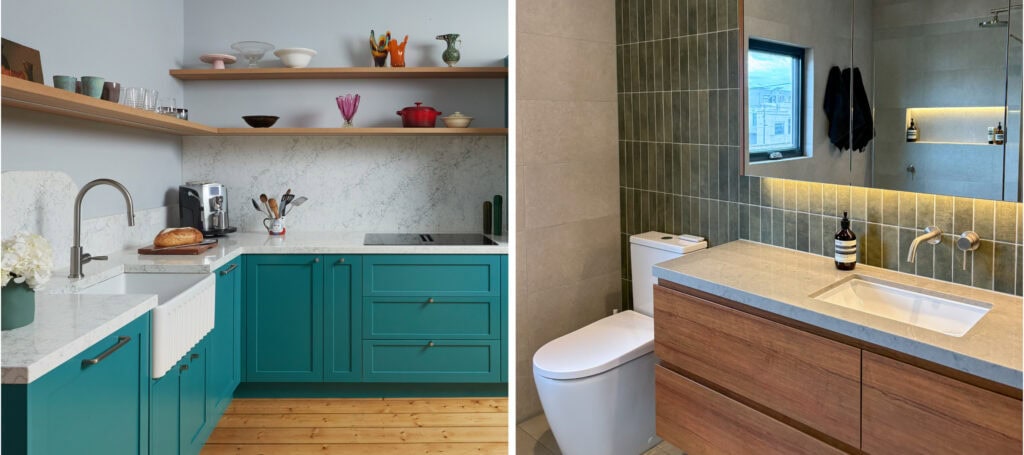
This innovative product emerged following the Australia-wide ban on engineered stone due to its high crystalline silica content. By combining natural minerals or alternative quartz aggregates with advanced polymer resins, manufacturers have created a new generation of surfaces. These products rival the organic beauty of natural stone while delivering superior practical benefits. Because they are entirely non-porous, these benchtops completely eliminate the need for ongoing sealing while actively resisting bacteria, mould, and staining.
Beyond their exceptional hardness and stain resistance, these zero-silica stones offer consistency in colour and pattern across slabs. They are available in a diverse range of finishes: from high-gloss polish to sophisticated matte textures, and can effortlessly mimic delicate marble veining in natural materials. Price points vary significantly, ranging from budget-friendly options to premium luxury tiers depending on the complexity of the design.
Pros
- High durability
- Low maintenance and easy to clean
- Uniform colour/ finishes
- Non-porous
- 100% compliant with the Australian Regulation
- Scratch resistance
- Lower price point range available
Cons
- Medium heat resistance
Natural Stone & Terrazzo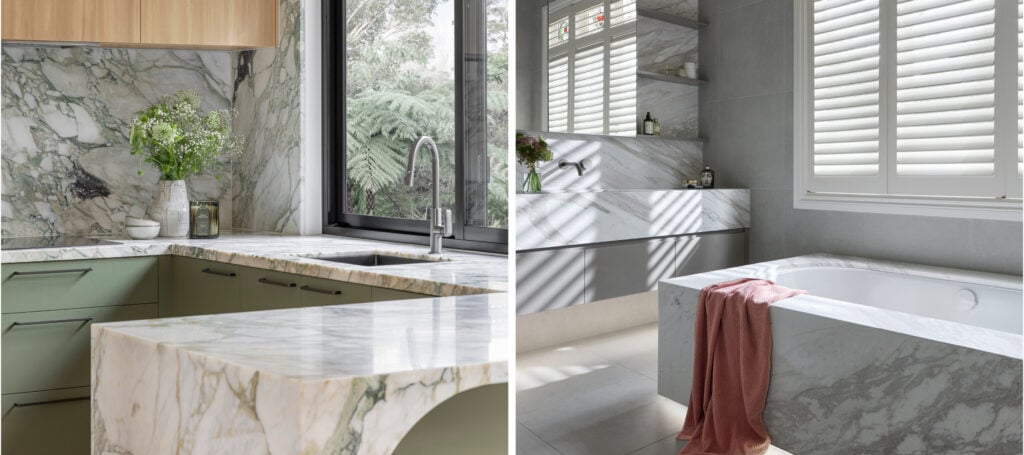
If you want a true showstopper, look no further than genuine natural stone. Because each individual slab is uniquely formed by nature, no two benchtops will ever be exactly alike. Mother Nature offers a myriad of breathtaking formations to suit every design taste. However, this luxury comes with a premium price tag. Natural stone is inherently porous and high-maintenance, meaning it must be sealed regularly to protect against staining and moisture absorption. Choosing it requires a shift in mindset: it is a surface that grows and patinas over time, where minor imperfections simply tell the story of your family’s daily life.
Popular varieties available on the market include granite, marble, limestone, and quartzite. Each varies significantly in porosity, hardness, and cost. While terrazzo is a composite material rather than a single quarried stone, it shares this luxury category by combining embedded chips of marble, quartz, and granite into a polished concrete or resin base for a highly durable, mosaic-like aesthetic.
Pros
- Beautiful and unique
- Can be buffed and repolished
- Myriad of colours to suit every look
- UV stable (naturally sourced from Mother Nature)
- High durability
Cons
- Most natural stones are porous
- High price point
- High maintenance
- Comes with natural imperfections
Solid Surface 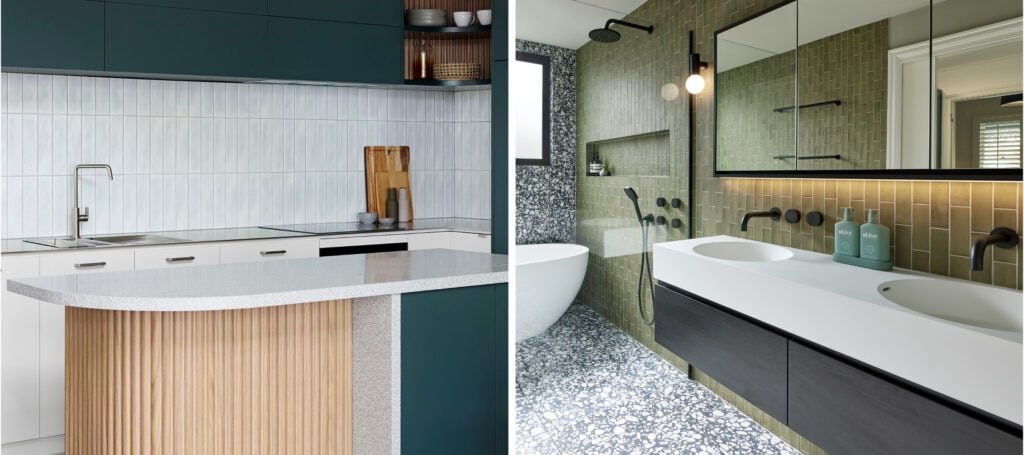
Crafted by blending natural minerals with acrylic binding agents, solid surface benchtops are both beautiful and exceptionally hard-wearing. This material is highly sought after for its completely seamless appearance, extensive range of colours, and low maintenance requirements. Because it is non-porous, it naturally resists stains, mould, and bacteria. This makes it an incredibly hygienic and easy-to-clean choice for kitchens, bathrooms, and laundry alike.
For a truly streamlined look, you can even integrate a matching solid surface sink directly into the benchtop, eliminating any grime-catching lips or joints. Additionally, it can be thermoformed or moulded into almost any shape, allowing you to easily incorporate modern curves into your design.
Pros
- Can be moulded into different shapes
- Can be repaired seamlessly and onsite
- Joints are seamless
- 100% non-porous & hygienic
Cons
- Poor heat resistance
- Prone to scratches
- Can feel ‘plasticky’
Stainless Steel
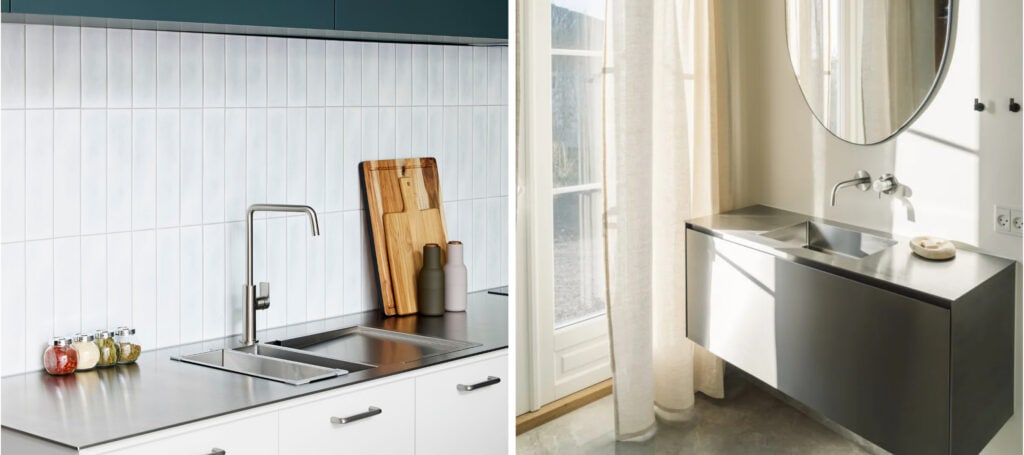 Image source: Caia Leifsdotter (Right).
The ultimate heavy-duty surface, stainless steel is the number-one choice for commercial kitchens. Thanks to its incredible durability and heat resistance, you can confidently place hot pans straight onto the surface without fear of damage. Because it is 100% non-porous, it stands out as an exceptionally hygienic option that is incredibly easy to clean. Sinks can be seamlessly welded directly into the benchtop, completely eliminating joints and grooves where mould or bacteria could otherwise breed. While it is prone to surface scratching, stainless steel patinas beautifully over time—a characteristic that many homeowners embrace as part of its rugged, evolving charm.
Stainless steel benchtops are steadily finding their place in residential homes as well. It is a versatile choice that effortlessly complements modern, contemporary, and industrial design styles.
Pros
- Heat-proof
- Highest durability
- Seamless sink and splashback integration
- 100% non-porous and hygienic
- Long-lasting
Cons
- Can look and feel ‘cold’
- Prone to scratches and dents
- Shows fingerprints and smudges
- High fabrication cost
Laminate
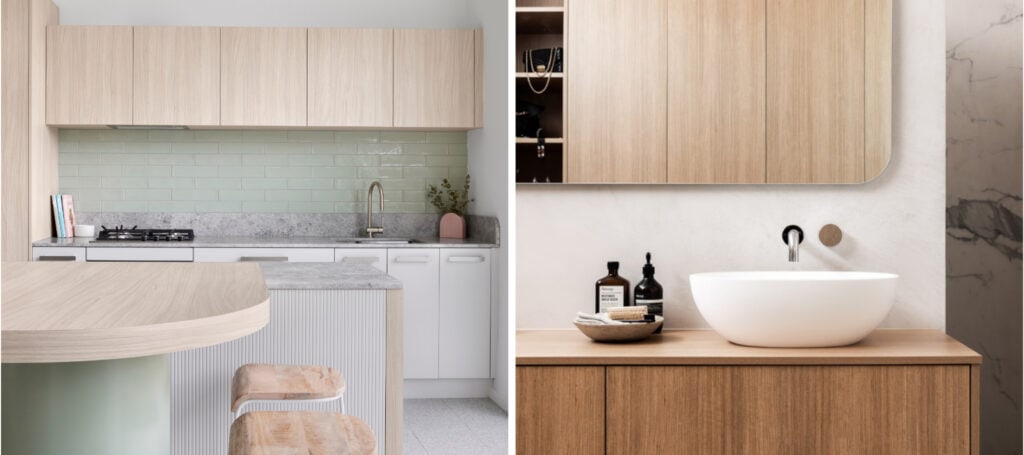 Image source: Laminex (Right).
Laminate is the ultimate budget-friendly hero of the renovation world. Made from layers of paper fused with a protective resin finish, the laminate sheet is bonded directly onto a particleboard or MDF core.
If you think laminate still looks cheap and dated, think again. Modern options convincingly mimic high-end stone, natural timber, and industrial concrete textures for a fraction of the price. They are hard-wearing, easy to clean, lightweight, and straightforward to install. However, they are not invincible; because they are fundamentally resin-coated paper over a wood-based core, they are not heat/water resistant.
Pros
- Lowest price point
- Large range of designs
- High impact resistance
Cons
- Poor moisture resistance
- Poor heat resistance
- Prone to scratches
- Visible joints
Porcelain
Imagine a giant, ultra-premium floor tile for your kitchen island: that is porcelain slab. Made from compressed powdered clay fired at extreme heat, it features digitally printed glazes that perfectly mimic rare marble and natural stone. This material is remarkably heat-resistant, scratch-resistant, non-porous, and completely UV stable. As a result, you can place hot pans straight from the oven onto the surface without a worry.
However, this “unicorn” of a benchtop does have major drawbacks. Because the slabs are massive but thin, they are highly fragile until installed. You will need a specialised, highly skilled fabricator to handle and cut them, which drives installation costs sky-high. Just like a tile, the edges can be sharp and prone to chipping if hit with a heavy pot. Plus, it handles house movement poorly; any joints or seams can easily crack over time.
Pros
- High heat-resistance
- UV stable, suitable for outdoor use
- Non-porous
- Highly stain-resistant
Cons
- Sharp edges
- Fragile
- Complex fabrication
- Prone to chipping and cracking
- Joints don’t last
- Surface-only pattern/design
- Mid-high price point due to complex fabrication
Sintered Stone
Think of sintered stone as porcelain’s tougher, smarter sister. While porcelain is made mostly from clay, sintered stone is engineered from 100% natural minerals fused together under extreme amounts of heat and pressure.
It shares all of porcelain’s best traits: it is non-porous, heat-proof, and UV stable. But it fixes porcelain’s biggest flaws, because it is compressed under much higher pressure, it offers superior thermal stability, making it less fragile and significantly easier for fabricators to cut and handle. Another major design advantage is its full-body mineral pigmentation. Unlike porcelain slabs, where the pattern is digitally printed only on the surface, the veining and colour of sintered stone run completely through the entire thickness of the slab.
Pros
- High heat resistance
- UV stable, suitable for outdoor use
- Non-porous
- Scratch and stain resistance
- Full-body pattern/design
- Higher stability on the cutting table than porcelain
Cons
- High price point
- Limited design
- Complex fabrication
Timber/Bamboo 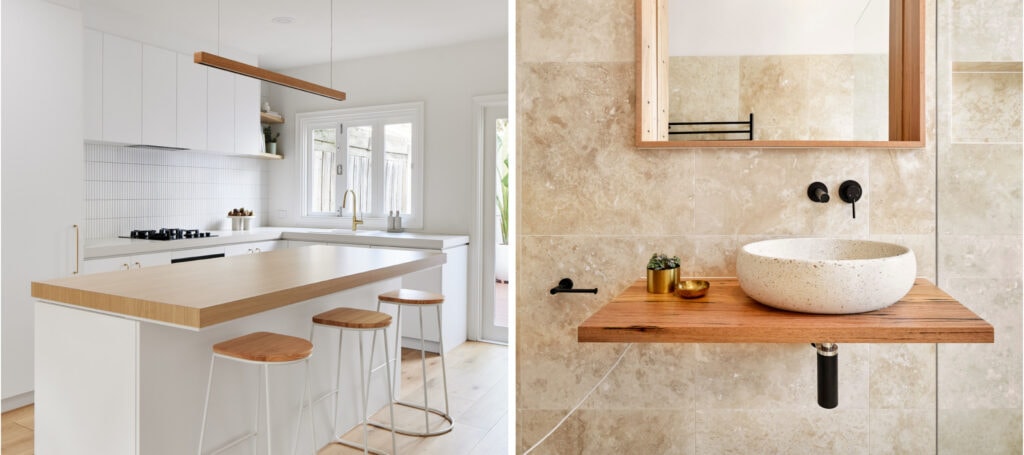
Timber benchtops instantly inject warmth into your space through the tactile qualities and organic patterns of natural wood. Timber does require more care as it can stain, scratch, and dent easily, but that often is part of it’s rustic charm. It is important to note that wood is not heat-resistant or moisture-resistant. To protect the surface from water damage and staining, timber benchtops must be coated regularly with either a food-safe oil or a polyurethane sealant. Much like natural stone, the cost of a timber benchtop varies wildly depending on the specific wood species and the complexity of the installation.
Pros
- Repairable
- Environmentally friendly
- Naturally warmer and softer
Cons
- Poor moisture resistance
- Poor heat resistance
- Prone to stains, scratches, and dents
If you have any general questions about renovating your bathroom or kitchen from an interior designer’s perspective, feel free to email me.
Inspiration and advice
Inspiration and advice
As featured in